When the Reaction Mixture Becomes the Screening Library
Drug Discovery News · Nov 6, 2026 · 16 min read
*Direct\-to\-Biology in Covalent Drug Discovery, Targeted Degradation, Macrocycles, and Peptide Research* Drug discovery rarely suffers from a shortage of molecular ideas\. The difficulty is deciding which ones deserve to be synthesized, purified, and investigated further\. In conventional medicinal chemistry, every new analogue typically passes through synthesis, workup, purification, characterization, and biological testing\. This is a sensible approach when working with a small number of well\-defined candidates\. It becomes increasingly expensive when a project requires hundreds of structural variations, most of which may ultimately prove inactive\. Direct\-to\-biology (D2B) offers a different experimental strategy\. Compounds are prepared through miniaturized chemical reactions, and the resulting crude or minimally processed mixtures are evaluated directly in compatible biological assays\. Purification and detailed characterization are concentrated on compounds showing promising activity\.
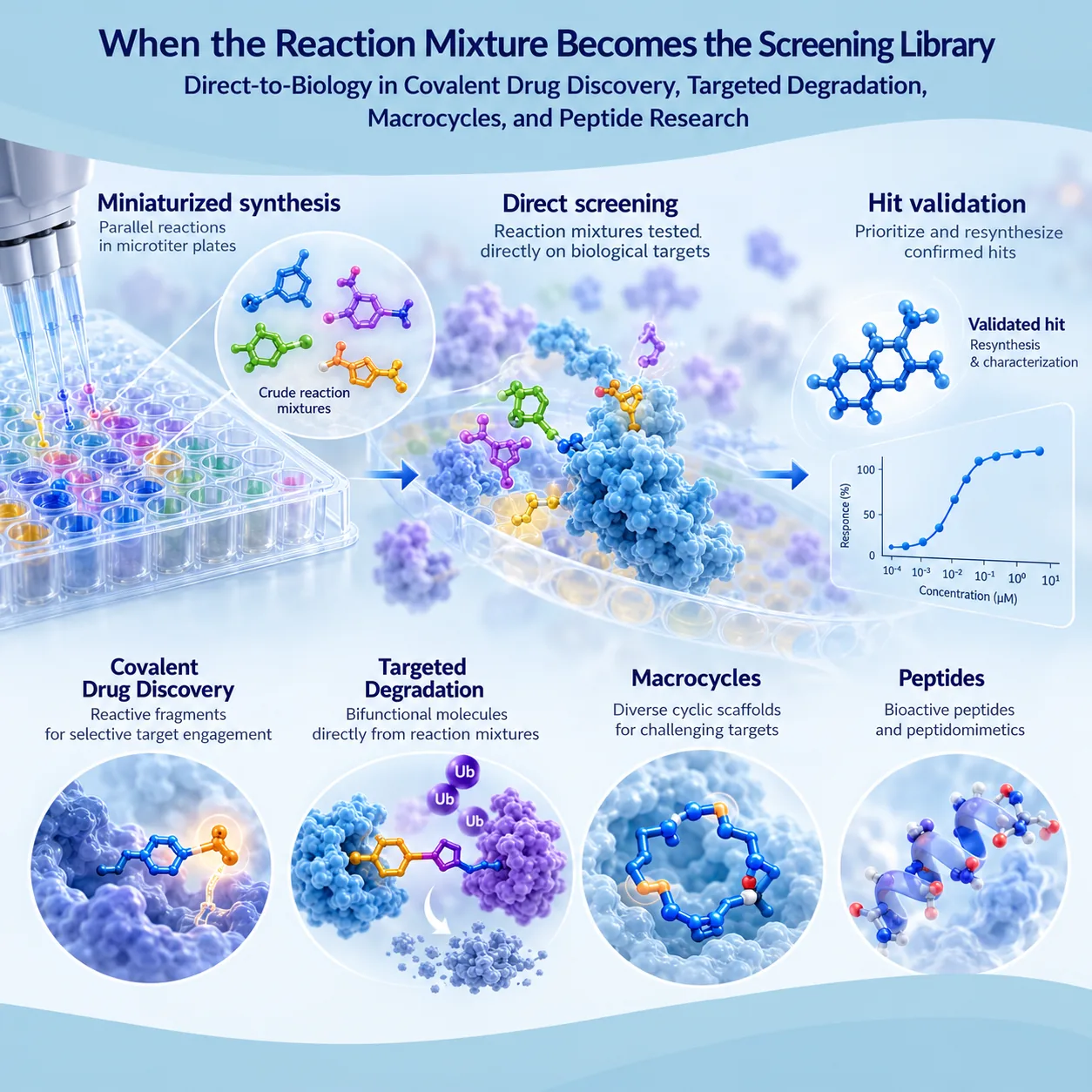
The principle is not new\. What has changed is the combination of reliable miniaturized chemistry, acoustic liquid handling, automated screening, and increasingly sensitive analytical techniques\. Recent reviews describe how D2B has progressed from relatively simple ligand optimization to covalent inhibitors, targeted degraders, molecular glues, and macrocycles\.
Its greatest advantage is not simply the ability to screen thousands of reactions\. D2B makes it possible to investigate combinations of structural features that would otherwise require an impractical amount of conventional synthesis\.
However, accelerating biological screening introduces a fundamental trade\-off: the identity and concentration of the active species are less certain than when purified compounds are tested\. Understanding that trade\-off is essential to designing experiments that produce meaningful medicinal chemistry data\.
## Covalent Ligands: Optimizing Recognition and Reactivity Together
Covalent ligand development involves more than placing an electrophilic group near a nucleophilic residue\. Productive inhibition depends on reversible recognition, warhead orientation, local protein environment, and the kinetics of covalent bond formation\.
Even relatively small structural changes can alter these properties substantially\.
D2B is particularly attractive here because it allows chemists to vary recognition elements and electrophilic functionalities systematically, then evaluate the resulting products without purifying every analogue\.
McPhie and colleagues demonstrated this approach in their work on TRIM25, a RING\-type E3 ubiquitin ligase that has remained relatively underexplored as a recruitment platform for induced\-proximity chemistry\.
Starting from covalent fragments targeting the PRYSPRY substrate\-binding domain, the researchers combined fragment screening with high\-throughput D2B optimization\. The resulting ligand showed target engagement in living cells, increased TRIM25 autoubiquitination in vitro, and was structurally characterized in complex with the protein\.
Importantly, the optimized ligand could also be incorporated into heterobifunctional molecules that induced TRIM25\-mediated ubiquitination of a neosubstrate in vitro\.
This opens an interesting direction for E3 ligase recruitment\. Covalent engagement may provide access to ligases that lack conventional reversible binding sites suitable for PROTAC development\.
The distinction between ubiquitination and degradation is important, however\. The TRIM25 study demonstrated induced neosubstrate ubiquitination, not a fully established cellular degradation mechanism\.
A second example comes from Kooij and colleagues, who used acoustic liquid handling to generate a library of 7,536 cyanimide\-containing compounds and screened them against a panel of ubiquitin and ubiquitin\-like proteases\.
The screening campaign identified selective inhibitors of mouse USP18 (mUSP18)\. Subsequent resynthesis and optimization produced BB07CA902, a covalent inhibitor with an IC50 of 35 nM\. Its activity was further supported by intact\-protein mass spectrometry, enzyme kinetics, selectivity profiling, and cellular experiments\.
The 35 nM result is particularly important to interpret correctly: it belongs to a purified, optimized inhibitor, not simply to an uncharacterized crude screening hit\.
More recently, Cai and colleagues applied a workflow combining covalent docking, D2B synthesis, and direct FRET\-based screening to identify inhibitors of the chikungunya virus nsP2 cysteine protease\.
Together, these studies illustrate how D2B can connect warhead diversification with experimental target inhibition, reducing the number of compounds that require preparative synthesis\.
The limitation is that apparent potency in a crude reaction does not necessarily reflect the intrinsic activity of the intended product\.
Unreacted electrophiles, reactive by\-products, or compounds with nonspecific thiol reactivity may contribute to inhibition\. Conversely, an active product may be missed when conversion is low or when residual reagents interfere with the assay\.
For promising covalent hits, purified\-compound testing should therefore be accompanied by suitable investigations of target engagement, covalent adduct formation, reaction kinetics, and selectivity\. Where mechanistically appropriate, these may include intact\-protein MS, peptide mapping, time\-dependent inhibition, and competitive chemoproteomics\.
D2B can identify which electrophilic structures are worth investigating\. It cannot, by itself, establish that their activity is selective or mechanistically relevant\.
## PROTACs: Screening the Combinations That Cannot Be Predicted Reliably
PROTAC optimization is particularly demanding because productive degradation depends on several interrelated factors\.
A compound must engage its protein of interest (POI) and recruit an E3 ligase, but binary binding alone is insufficient\. The geometry and stability of the resulting ternary complex, ubiquitination efficiency, cellular exposure, and the availability of productive lysine residues all influence degradation\.
Linker length, attachment points, flexibility, and polarity may determine whether a bifunctional molecule works at all\.
As a result, two PROTACs with similar binary affinities and physicochemical properties may display very different degradation profiles\.
D2B allows medicinal chemists to investigate these relationships through larger, systematically organized libraries\.
Mitrović and colleagues provided a convincing demonstration in their 2026 Journal of Medicinal Chemistry publication, Click\. Screen\. Degrade\.
Using copper\-catalyzed azide–alkyne cycloaddition (CuAAC), the researchers established a miniaturized workflow with reaction volumes as low as 5 μL\.
Their modular collection comprised 48 azide\-functionalized E3 ligand–linker building blocks: 36 based on CRBN\-binding chemotypes and 12 based on VHL ligands\. Combining these with four alkyne\-functionalized POI ligands per target provided access to 192 PROTAC structures for each protein\.
The methodology was applied to BRD4, soluble epoxide hydrolase, WDR5, and Aurora kinase A, followed by direct cellular degradation screening\.
The results illustrated that productive linker architectures and E3 recruitment strategies are target\-dependent\. Incubation time also influenced the degradation responses observed in some experiments\.
One observation deserves particular attention\.
When the researchers tested the influence of residual starting materials, the presence of only 10% unreacted alkyne\-containing POI ligand substantially reduced the apparent BRD4 degradation efficacy of a reference PROTAC\.
This demonstrates a weakness of crude\-mixture screening that is especially relevant for bifunctional compounds\. Residual POI ligands can compete with PROTACs for target binding, while unreacted E3 ligands may compete for ligase recruitment\.
Thus, reduced degradation in a crude well may reflect competition from starting materials rather than poor intrinsic activity of the desired PROTAC\.
A nominal screening concentration calculated from the theoretical product yield also does not necessarily correspond to the actual PROTAC concentration\.
These effects make reaction conversion and carefully designed controls essential\.
Nevertheless, the advantages are substantial\. With sufficient reaction quality, D2B enables early identification of productive linker arrangements, comparison of CRBN\- and VHL\-based recruitment, and rapid prioritization of promising degrader combinations\.
It can also reveal whether a target responds to particular recruitment strategies before extensive synthesis resources are committed\.
What D2B does not establish automatically is the full degradation mechanism\. Prioritized compounds still require purified dose–response characterization, assessment of cellular exposure, appropriate proteasome\- and E3\-dependence controls, and confirmation of target degradation\.
For difficult targets, however, systematically testing a larger set of combinations may be considerably more informative than preparing a small number of compounds selected mainly by chemical intuition\.
## Molecular Glues: When Screening Measures More Than Binding
Molecular glue discovery presents a different challenge\.
Unlike conventional inhibitors, molecular glues can generate biological activity by stabilizing or inducing interactions between proteins\. Their behavior may depend on a composite molecular interface that is not present in either isolated protein\.
Consequently, screening exclusively for binding affinity to one protein can miss compounds whose most important property is their ability to promote protein proximity\.
Hu and colleagues addressed this problem through a D2B workflow involving more than 20,000 crude reaction mixtures and affinity\-selection mass spectrometry (ASMS)\.
Rather than screening only against CRBN or LCK individually, the researchers compared ligand enrichment in the presence of the CRBN–LCK protein pair with enrichment against the individual proteins\.
This strategy helped distinguish compounds preferentially associated with the ternary system from conventional binary binders\.
Following resynthesis, the selected compounds were investigated using orthogonal proximity assays\. Several induced LCK degradation in cellular experiments, supporting the biological relevance of the screening strategy\.
The study provides an important example of how D2B can be combined with a readout designed around the mechanism of interest rather than conventional single\-protein binding\.
A complementary approach was reported by Shaum and colleagues\.
Using sulfur(VI) fluoride exchange (SuFEx) chemistry, the researchers diversified established ENL\- and BRD4\-binding scaffolds using a collection of 3,163 building blocks\.
Screening these analogues for degradation uncovered compounds with distinct E3 recruitment mechanisms\.
One ENL degrader, dHTC1, recruited the CRL4–CRBN machinery through a protein–protein interface in which CRBN engagement depended on the preformed ENL–compound complex\. Another compound, dHTC3, promoted BRD4 degradation through FBXO3\-containing SCF E3 machinery\.
These findings extend the value of D2B beyond conventional ligand optimization\. Systematic chemical diversification can expose previously unrecognized protein recruitment mechanisms\.
However, the two studies also demonstrate that no single screening method captures every molecular glue mechanism\.
ASMS\-based enrichment depends on the stability and behavior of the complexes under the experimental conditions\. Cellular degradation screening measures a downstream biological outcome, but it does not independently identify the responsible E3 ligase or establish how proximity is induced\.
Protein abundance, complex assembly, permeability, cytotoxicity, and assay interference can influence the result\.
For molecular glue discovery, D2B is therefore most powerful when combined with orthogonal methods such as biochemical proximity assays, structural studies, proteomics, and genetic validation of the recruited machinery\.
The chemistry generates diversity; the biology determines which interactions that diversity can reveal\.
## Macrocycles: Accessing Chemical Space That Is Expensive to Explore
Macrocycles offer opportunities to recognize protein surfaces that are difficult to address with conventional small molecules\.
Their constrained but potentially adaptable conformations can support complex molecular recognition, including interactions with extended binding sites and protein–protein interfaces\.
Some macrocycles also exhibit favorable cellular permeability despite relatively high molecular weight and polarity\. However, this behavior is strongly structure\-dependent and cannot be assumed from macrocyclization alone\.
From a synthetic perspective, macrocycle optimization can be demanding\. Changes in ring size, stereochemistry, side\-chain composition, or cyclization chemistry may significantly affect both conformational preferences and biological activity\.
D2B makes these variables easier to investigate experimentally\.
Danková and colleagues generated a 4,608\-member macrocycle library in 1,536\-well plates and screened the unpurified compounds for inhibition of histone deacetylase 11 (HDAC11)\.
The library incorporated diverse amino acids, aminothiol components, and cyclization linkers, together with hydroxamic acid functionality designed to support interaction with the enzyme\.
Following hit selection, resynthesis, purification, and characterization, the team identified a selective macrocyclic inhibitor with a Ki of 40 nM\.
The study also provided evidence of cellular permeability using the chloroalkane penetration assay, demonstrating that the approach could yield more than biochemical binders\.
For macrocycle discovery, the major benefit of D2B is the ability to explore structural and conformational diversity without preparing every candidate at conventional medicinal chemistry scale\.
The corresponding limitation is that cyclization reactions may generate mixtures of desired macrocycles, uncyclized precursors, oligomers, or other side products\. Furthermore, ring closure can be highly dependent on sequence and stereochemistry\.
A biologically active reaction mixture therefore requires careful structural identification before SAR conclusions can be drawn\.
High\-throughput synthesis is most valuable when its analytical methods can distinguish genuine structure–activity relationships from variations in reaction outcome\.
## Peptides: Combinatorial Screening Beyond One Compound per Well
Peptide research presents another opportunity to combine modular chemistry with functional screening\.
Conventional solid\-phase peptide synthesis allows enormous flexibility in sequence composition, stereochemistry, noncanonical amino acids, and backbone modification\. Producing and individually screening hundreds of thousands of purified peptides, however, remains resource\-intensive\.
Zarda and colleagues recently demonstrated a strategy that expands the number of peptide combinations accessible through direct functional screening\.
Their approach used thiol\-functionalized peptide fragments connected through disulfide formation\.
By pairing different peptide building blocks, a relatively limited collection of starting fragments could generate a much larger set of dimeric structures\.
Acoustic liquid transfer enabled combinatorial assembly and screening in 1,536\-well plates\. The researchers tested approximately 800,000 peptide combinations and identified thrombin inhibitors with nanomolar inhibitory constants\.
The most potent validated heterodimer reported in the study had a Ki of 28 ± 1 nM\.
A particularly interesting aspect is that the large\-library experiment used pooled peptide fragments, allowing multiple possible dimers to be generated within one well\.
This differs from conventional one\-compound\-per\-well D2B\. Active mixtures required deconvolution to identify the responsible peptide pair\.
The study also illustrates why chemical characterization remains indispensable\. During follow\-up, some active components were found to contain truncated or otherwise modified peptide sequences rather than the initially intended structures\.
In other words, the screen successfully identified biological activity, but chemical analysis was necessary to determine exactly which molecules produced it\.
The disulfide connection introduces another consideration\. Such linkages may be unstable or exchange under reducing biological conditions, potentially limiting direct translation to intracellular targets\.
Nevertheless, the concept is compelling: a large functional peptide library can be assembled from a manageable number of chemically accessible fragments, with detailed synthesis focused on the most promising combinations\.
For peptide and peptidomimetic discovery, this creates opportunities to investigate proteases and protein–protein interactions while maintaining access to noncanonical structural diversity\.
Whether the resulting compounds have suitable permeability, stability, and pharmacological properties remains a separate question\.
## Antibodies and ADCs: Related Automation, Different Constraints
The pressure to accelerate synthesis and screening is not confined to small molecules\.
Antibody engineering and antibody–drug conjugate (ADC) development also involve large numbers of possible variants, conjugation conditions, and linker–payload combinations\.
Recent advances offer related approaches to reducing experimental effort\.
Kim and colleagues introduced MAXTIA, combining cell\-free protein synthesis with high\-throughput surface plasmon resonance to characterize the binding kinetics of up to 384 protein variants within three days\.
Roberts and colleagues developed an automated platform for stochastic antibody–drug conjugation and drug\-to\-antibody ratio characterization\.
These are not direct demonstrations of conventional crude\-mixture D2B screening\. They illustrate complementary developments in automated experimental workflows\.
The distinction matters because ADCs introduce additional analytical requirements\. Drug\-to\-antibody ratio distributions, conjugation\-site heterogeneity, aggregation, unconjugated payload, and antibody integrity may all affect biological results\.
For these reasons, applying D2B principles to conjugates requires more extensive analytical control than direct screening of many small\-molecule reaction mixtures\.
Where D2B Works — and Where It Can Mislead
The success of a D2B campaign depends on a balance between chemical reliability, assay tolerance, and the amount of information generated\.
Not every reaction that works on a preparative scale will perform reliably in a nanomole\-scale plate format\.
Amide couplings, click reactions, selected substitution reactions, and other modular transformations are particularly attractive because their conditions can often be adapted to parallel synthesis\.
More demanding reactions may be limited by catalyst compatibility, conversion, solubility, reaction atmosphere, side\-product formation, or sensitivity to miniaturization\.
Three practical considerations deserve particular attention\.
### 1\. Conversion and product identity
A screening well does not necessarily contain the intended compound at its nominal concentration\.
Incomplete reactions create uncertainty in the amount of product present\. This can produce false negatives, distort SAR, and complicate comparisons across a library\.
Depending on the chemistry, LC\-MS, HPLC\-UV, or other analytical methods may be needed to monitor product formation and identify problematic reactions\.
Importantly, MS confirmation of the expected molecular mass is not sufficient to establish purity, stereochemical identity, or the absence of interfering substances\.
For D2B, reaction analytics are not an optional finishing step\. They determine how confidently biological measurements can be interpreted\.
### 2\. Biological assay compatibility
Crude mixtures may contain residual solvents, catalysts, reagents, unreacted starting materials, salts, and side products\.
These components can interfere with target proteins, cellular viability, fluorescent or luminescent readouts, and other assay systems\.
The risks differ between modalities\.
For covalent inhibitors, residual electrophiles may cause nonspecific protein modification\. For PROTACs, starting ligands may competitively interfere with target or E3 engagement\. For molecular glues, mixture components may influence protein binding or cellular phenotypes\.
Reaction blanks, starting\-material controls, suitable counterscreens, and independent confirmation with purified compounds are therefore central to a reliable workflow\.
The goal is not necessarily to eliminate every impurity before initial screening, but to establish that the assay can tolerate the reaction matrix well enough to produce useful results\.
### 3\. Interpreting hits and building reliable SAR
The first D2B screen is a prioritization experiment, not a definitive potency assessment\.
A strong response indicates that a particular reaction mixture deserves further investigation\. A weak response does not automatically mean that the intended product is inactive\.
This distinction becomes especially important when comparing reaction wells with different conversion levels or when products have different solubility and stability\.
Validated hits should be resynthesized, purified, structurally confirmed, and tested in appropriate concentration–response experiments\. Mechanism\-specific follow\-up is then required\.
The quality of D2B\-derived SAR ultimately depends on connecting biological responses to chemically verified structures\.
## The Advantage Is Better Experimental Selection, Not Simply More Compounds
One of the most useful consequences of D2B is a change in how medicinal chemistry resources are allocated\.
Instead of fully preparing hundreds of speculative structures, chemists can investigate a broader design space and then concentrate purification, characterization, and mechanistic studies on a smaller set of candidates\.
This can reduce consumption of starting materials and solvents, shorten initial optimization cycles, and make projects with complex multidimensional SAR more experimentally accessible\.
But library size alone is a poor measure of success\.
Ten thousand poorly controlled reactions may provide less useful information than a few hundred well\-designed experiments with reliable conversion and compatible biological readouts\.
The best D2B collections are therefore not necessarily the largest\. They are the ones designed around clear chemical hypotheses, robust transformations, suitable controls, and assays capable of distinguishing meaningful biological activity\.
This places considerable value on building\-block selection\.
Diverse electrophilic warheads, defined E3 ligands, carefully designed linkers, functionalized fragments, and peptide or macrocycle precursors determine which chemical relationships can be investigated\.
Their quality, chemical accessibility, and compatibility with miniaturized reaction conditions are just as important as structural diversity\.
## Chemistry Expertise Behind a Successful D2B Campaign
For Enamine Deutschland, these developments are particularly relevant because D2B depends on the integration of building\-block selection, medicinal chemistry, high\-throughput synthesis planning, and biological evaluation\.
Enamine Deutschland combines access to Enamine’s extensive building\-block and screening\-compound collections with local chemistry capabilities in Frankfurt am Main\.
This provides a foundation for designing focused compound libraries and selecting suitable chemical transformations, including projects involving covalent ligands, bifunctional compounds, linkers, macrocycles, and other challenging molecular architectures\.
Frankfurt\-based synthesis can also support rapid follow\-up of promising compounds, particularly when resynthesis, purification, structural confirmation, and further medicinal chemistry optimization are required\.
Biological evaluation is equally important\. Where appropriate, assay planning and screening can be organized through collaboration with specialist biological research teams and external CRO partners according to project requirements\.
The practical value lies in aligning the chemistry with the biological question from the beginning: choosing reliable reactions, defining meaningful controls, establishing analytical requirements, and planning how screening hits will be validated\.
D2B is not the right solution for every project\. Its suitability depends on the transformation, the assay, the target, and the required quality of the experimental data\.
However, when these elements are properly matched, it offers a powerful way to explore chemical space that would otherwise remain inaccessible through conventional iterative synthesis\.
## A More Direct Route from Chemical Ideas to Biological Evidence
Direct\-to\-biology will not replace purification, conventional medicinal chemistry, or detailed mechanistic studies\.
Its strength is that those resources can be directed toward compounds that have already produced useful experimental evidence\.
For covalent ligands, it enables rapid investigation of recognition elements and electrophilic functionality\. For PROTACs, it makes broader testing of linker and E3 recruitment combinations practical\. For molecular glues, it supports functional discovery of unexpected protein interactions\. For macrocycles and peptides, it reduces the synthetic burden of exploring complex molecular diversity\.
The central challenge remains interpretation\. A crude reaction mixture can reveal promising biology, but understanding which molecule is responsible—and why it works—still requires rigorous chemistry\.
The future value of D2B will depend less on how many reactions can be screened than on how reliably each experiment connects chemical structure to biological function\.
Sources
Enamine Germany