SuFEx cyclization, conformational control, and why macrocycle library quality beats library size
Drug Discovery News · Nov 13, 2026 · Chemistry Library · 5 min read
A macrocyclic peptide library can contain more members than there are people in Europe and still return nothing you can develop. We have known this for a while. What we have been slower to accept is where the problem sits: not in the biology, not in the sequence space, but in the two or three atoms we use to close the ring and then stop thinking about. A recent paper from Merck & Co. (MSD outside North America) makes that point hard to ignore. Mi, Fan, Scott and co-workers describe a sulfur(VI) fluoride exchange (SuFEx) macrocyclization that works on DNA, in water, and — this is the part worth reading twice — produces a ring-closing linkage that behaves as a conformational design element rather than a piece of plumbing.
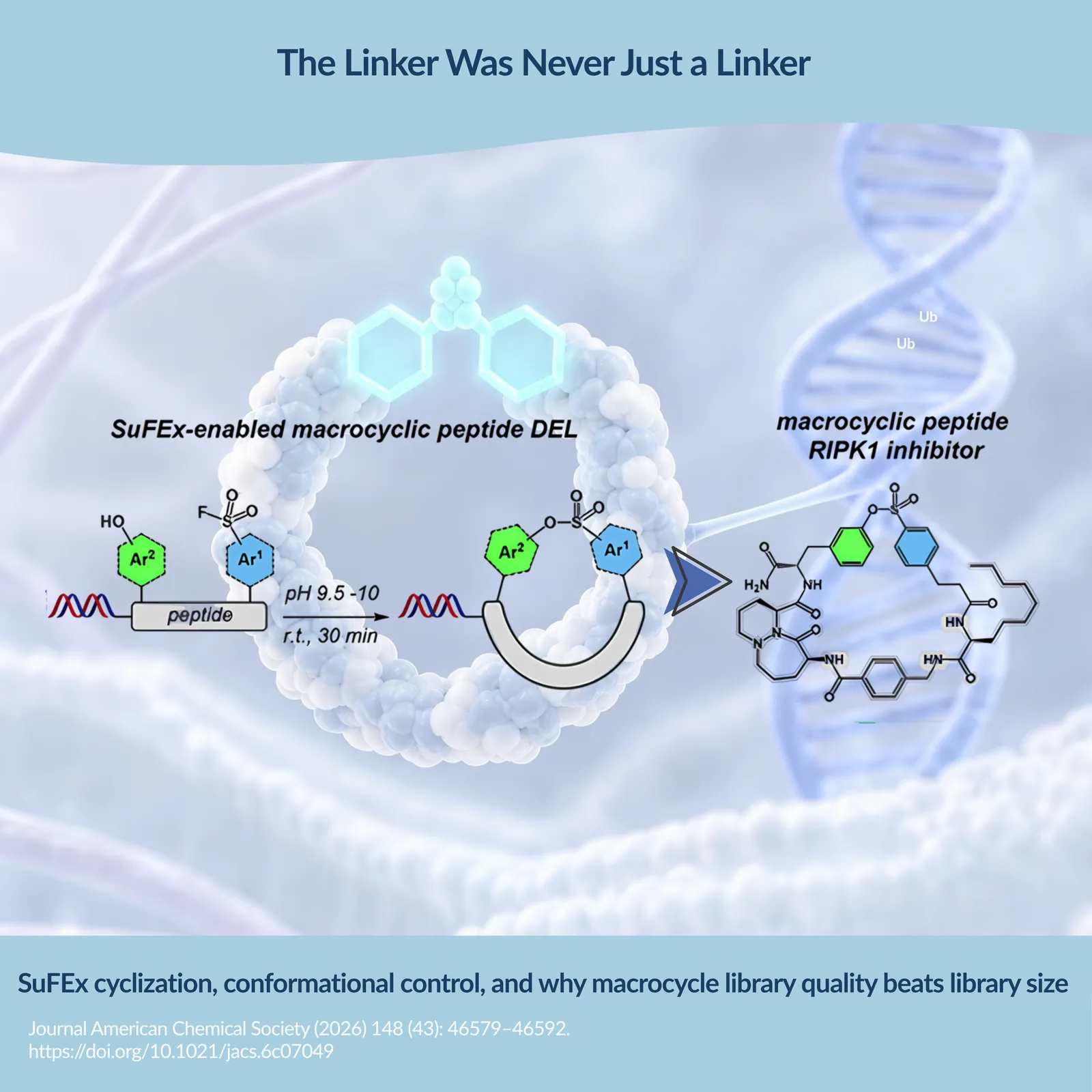
The design is elegantly simple. A phenol and an aryl sulfonyl fluoride are embedded within the same DNA-tagged peptide. Dissolve it in basic aqueous buffer and the intramolecular SuFEx fires immediately - no catalyst, no metal, no coupling reagent, no organic cosolvent to insult the DNA barcode.
The scope is broad: rings of 15 to 52 members, built from diverse amino acid compositions. The conditions translate off-DNA to give sulfonate- and sulfonamide-linked macrocycles, which is the part that matters for resynthesis. And it scaled: the authors built a 343-million-member encoded macrocyclic peptide library, ran affinity selection against RIPK1, and validated an off-DNA hit with an ADP-Glo EC₅₀ of 174 nM to their knowledge the first cyclic-peptide inhibitor of that kinase.
For anyone who has watched a peptide macrocyclization campaign die of oligomerization, sequence-dependent conversion, or a solvent system the DNA tag cannot survive, this is a genuinely useful addition to the toolbox. But it is not the most interesting result in the paper.
The result that should change how libraries are designed. The NMR work is the real news. Changing the aryl substitution pattern and the linker length of the SuFEx-derived biaryl shifts the peptide backbone between extended strands and rigid turns, same sequence, different conformational preference, controlled by the cyclization chemistry alone.
Ring closure stops being a fixed synthetic step and becomes an SAR variable you can run matched molecular pairs on. Two macrocycles with identical residues can present their pharmacophore in geometries that a protein will treat as entirely different ligands. We have always known this in principle; here there is a handle on it that does not require redesigning the peptide.
This converges nicely with the computational side. Salveson and colleagues showed that structured macrocyclic oligoamides can be designed to populate a single low-energy conformer: from roughly 15 million predicted ring-closing combinations, 18 macrocycles were synthesized and 15 matched their design models closely, and the approach delivered Mpro inhibitors down to 0.88 µM. Design predicts the conformer; SuFEx offers an experimental dial to tune one. The two are complementary, not competing.
The question has to ask next. Before anyone builds 300 million members around a new linkage, somebody has to characterize that linkage as a structural feature of a drug candidate - not as a synthetic convenience.
Aryl sulfonate esters and sulfonamides are not interchangeable. They differ in polarity contribution, in conformational rigidity, in hydrolytic behaviour, and in how an esterase-rich compartment will treat them. An activated aryl sulfonate that closes a ring quickly in buffer at pH 9 is, by construction, an electrophile-derived ester, the hydrolytic and metabolic fate across pH 1.2 to 7.4 and in hepatocytes is an empirical question, not an assumption. The sulfonamide-linked series is the obvious de-risked fallback, and the trade-off against conformational control should be measured, not argued.
There is also the plain arithmetic of beyond-rule-of-5 space. A biaryl sulfonate adds polarity and TPSA in exchange for rigidity. Both move permeability , in opposite directions. Which one wins is a property of the whole macrocycle, which is precisely why it has to be determined per series.
And the RIPK1 hit, impressive as it is, is a biochemical result. Cellular target engagement, exposure, and selectivity against the broader kinome are separate programs. The paper establishes the method. It does not yet establish the compound.
Bigger libraries are not better libraries
Put four numbers next to each other and the pattern is uncomfortable. Zhu and colleagues built a DNA-encoded macrocyclic peptide library of 2.4 × 10¹² members in 2018 and identified binders against VHL and the RSV N protein — a remarkable technical achievement that produced binders. Mata and colleagues built 16 million fully synthetic, barcode-free macrocycles (CycloSEL, decoded by de novo tandem MS rather than DNA), screened against WDR5, and optimized a single confirmed hit into a chameleonic macrocycle that disrupts the WDR5–MLL interaction with an IC₅₀ of 128 nM, shows passive PAMPA permeability, serum stability, and antiproliferative activity in leukemia cells. Merz and colleagues synthesized 8,448 small cyclic peptides, average mass around 650 Da - screened them against thrombin, and reached oral bioavailability of 18% in rats. For a cyclic peptide, where sub-2% is typical, that is a different category of result. Five orders of magnitude separate the largest of these libraries from the smallest. The smallest two produced permeable, exposed compounds. The difference is not throughput. It is that drug-like constraints were designed into the library before the first selection, rather than hoped for afterwards.
This is where the chameleon literature earns its place. Poongavanam, Kihlberg and colleagues laid out how certain beyond-Ro5 compounds dynamically shield polar functionality in apolar environments and expose it in water, reconciling solubility with permeability. That behaviour is conformational. Which brings us back to the linker, because a cyclization chemistry that tunes backbone conformation is, in principle, a cyclization chemistry that tunes chameleonicity. Nobody has demonstrated that for SuFEx macrocycles yet. It is the experiment I would want to see.
What a useful next library looks like. Not larger. Structured.
Take a fixed recognition sequence and vary only the ring closure: linker length, aryl substitution pattern, attachment position, sulfonate versus sulfonamide. Measure affinity, solution conformation, PAMPA, aqueous and metabolic stability on the same set. That is a small library - hundreds, not millions - and it would tell us something no 343-million-member selection can: which conformational changes actually buy developability.
Then push past canonical peptides. N-methylation, non-canonical residues, partially non-peptidic backbones, rigid heterocyclic fragments in the ring. Bacterial and phage display are moving the same direction from the biology side Dawodu and Tharp recently showed surface display of macrocyclic peptides cyclized by cysteine-reactive unnatural amino acids directly on the E. coli outer membrane, which opens on-cell selectivity screening that DEL formats cannot easily do.
The Merck study adds a good reaction to the macrocycle toolbox. Its more durable contribution is the reminder that in a macrocycle, every atom in the ring is a design decision - including the ones we used to call the linker.
Sources
Enamine Germany