One substituent apart. How BCL6 settled the argument between blocking and removing
Drug Discovery News · Nov 9, 2026 · Targeted Protein Degradation · 10 min read
For twenty years BCL6 refused to behave like a drug target. Its co-repressor groove is wide, shallow and polar, and BCL6's own binding partner sits there at only 30 µM, so any inhibitor had to beat a weak natural ligand on an unpromising surface. Boehringer Ingelheim eventually got to 3 nM, and then the pharmacology failed to follow: one of their compounds barely slowed lymphoma cells. Its equipotent near-twin, differing only in the group most chemists would treat as a solubilising handle, degraded BCL6 outright and killed the same cells. Three more years and a cryo-EM structure went into finding out why. On 14 December, Arvinas reports the first clinical data on ARV-393 (zaloblideg), an oral PROTAC BCL6 degrader, in patients with non-Hodgkin lymphoma. This review follows the chemistry that made that trial possible, from 79-6 at 129 µM through a subpocket holding five ordered water molecules to the two cereblon-recruiting degraders now in the clinic. It also reads the announcement carefully: what the poster will contain, what it will not, and the three things worth looking for in its PK/PD.
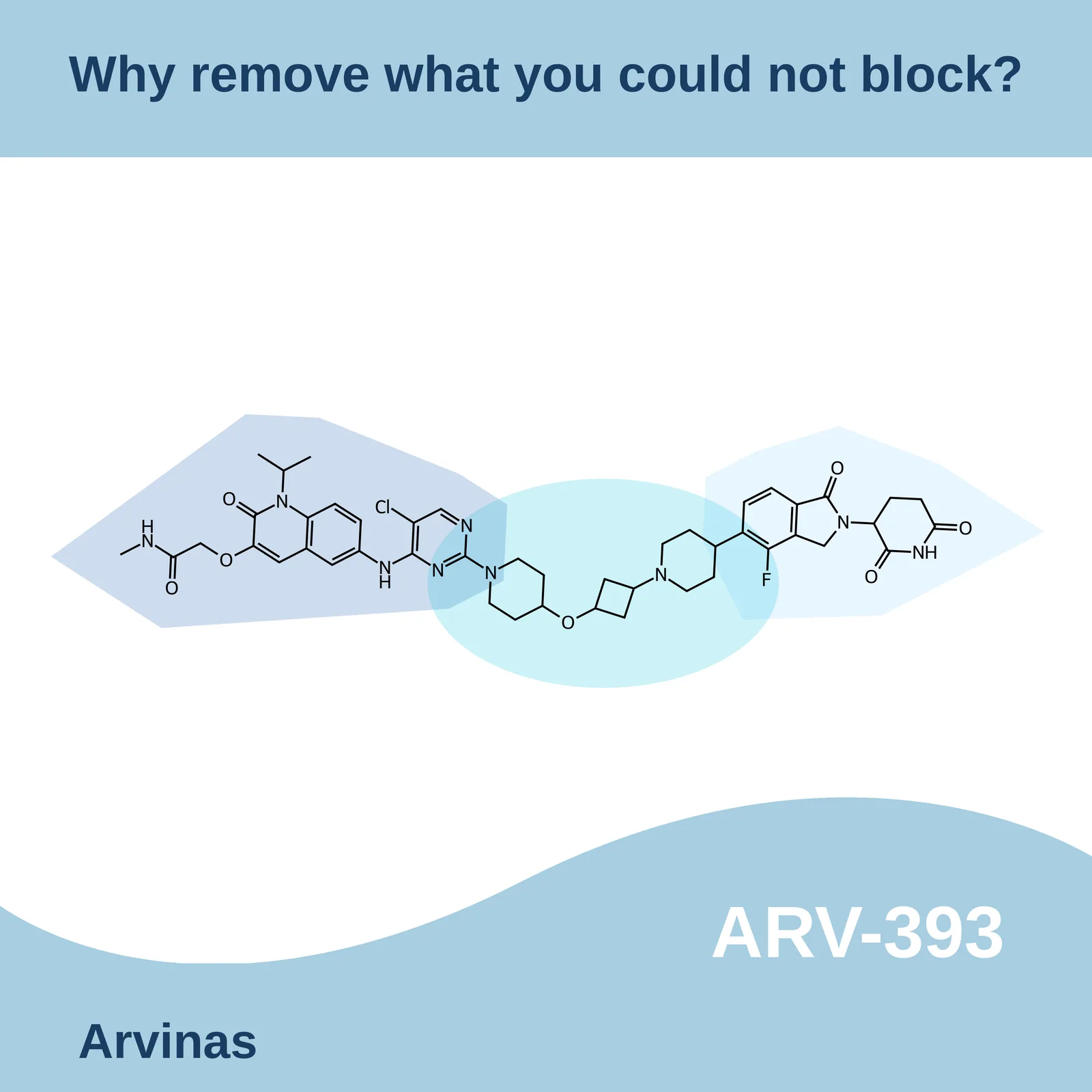
On 4 November 2026 Arvinas announced that the first clinical data for ARV-393 (zaloblideg), an oral PROTAC BCL6 degrader, will be presented at ASH on 14 груд. 2026 р.. BCL6 deserves the attention of anyone working on degraders, because the case for removing this protein rather than inhibiting it was not made by a platform argument. It was made twenty years into the medicinal chemistry by two compounds that differed in a single solvent-exposed group.
A groove that beat everyone
BCL6 represses transcription through its BTB domain, which binds the BCL6-binding domains of co-repressors including SMRT, NCOR and BCOR. The chemistry problem shows up in one number: the natural SMRT peptide binds the BTB lateral groove with a KD of 30 µM. The protein's own partner is a weak ligand on a wide, shallow, largely polar surface, and any small molecule has to beat it there.
The first generation did not. 79-6 bound with a KD of 129 µM and gave a reporter IC50 around 318 µM. Its crystal structure did show one molecule sitting in each lateral groove of the BTB dimer, which at least confirmed the site was addressable.
FX1 came out of SILCS-guided optimisation on that scaffold and reached KD 7 µM with a reporter IC50 near 35 µM. What mattered was not the tenfold gain in cells. It was that FX1 finally bound BCL6 about four times more tightly than the endogenous co-repressor does, while staying selective against other BTB-domain proteins including LRF, and it worked in both GCB- and ABC-DLBCL xenografts. Other groups came at the same groove differently: thiourea series from NMR fragment screening with computer-aided design, and a quinolinone series optimised by growing into a subpocket of the peptide groove that held a network of five stably bound water molecules. Displacing ordered water to buy affinity is routine. Finding five orderly waters in a groove the field had written off as featureless was the useful part.
Nanomolar, and still barely active
Boehringer Ingelheim closed the potency gap with structure-based design. Starting from a screening hit, they optimised to BI-3812 and BI-3802, both blocking the co-repressor interaction with IC50 values at or below 3 nM. Three crystal structures went into the PDB with that paper. The work turned the BCL6 BTB domain from a cautionary example into a druggable one, and by extension opened the wider BTB family.
Then the pharmacology refused to follow the potency. BI-3812, a clean low-nanomolar interaction inhibitor, derepressed BCL6 target genes and stopped proliferation only at concentrations far above its biochemical potency. BI-3802, an equipotent analogue, depleted BCL6 protein outright, derepressed target genes strongly, and killed DLBCL lines where BI-3812 did almost nothing. The authors put it plainly: the degrading compounds exceeded their equipotent non-degrading inhibitors.
This is the result that reframed the target, and it is worth being precise about why. Occupying the lateral groove blocks one co-repressor contact. BCL6 also represses through regions outside the BTB domain, so blocking that one contact leaves much of the machine running. Removing the protein does not. Degradation was not a modality preference here. It was the readout from two molecules that bound the same pocket with the same affinity and did different things to the cell.
The accident in the solvent channel
Nobody had designed that mechanism, and for three years nobody knew what it was. Słabicki and colleagues worked out why. Cryo-EM at 3.7 Å showed BI-3802 sitting at the interface between BCL6 homodimers, its pyrimidine ring stacking against BCL6 Tyr58, forming a composite ligand-protein surface that lets homodimers assemble into helical filaments. Genome-wide CRISPR screens identified SIAH1, a non-cullin E3 ligase, as the enzyme that ubiquitinates the polymer, with the BCL6-SIAH1 interaction induced at an EC50 of 64 nM. BI-3812 carries a dimethyl amide that would clash sterically in that assembly, so it occupies the same pocket and polymerises nothing. Adding excess BI-3812 dissolves the foci again.
So BI-3802 is a molecular glue that works by polymerising its own target, and the group responsible sits exactly where a chemist would normally install a solubilising handle. The general lesson is worth keeping: on a dimeric or oligomerisation-competent target, the solvent-exposed vector can determine mechanism rather than just physicochemistry. That is something to test, not assume.
Two other findings from the same work matter for anyone reading the clinical data. BI-3802's activity was described as superior not only to non-degrading inhibitors but to the heterobifunctional BCL6 degraders then available, which says the early bifunctionals were leaving something on the table. And BI-3802 was never a candidate: its bioavailability was poor enough to limit even animal work, which is part of why deuterated and metabolically stabilised analogues show up in the later patent literature.
Degrading on purpose
Two heterobifunctionals then took the deliberate route, recruiting cereblon instead of relying on SIAH1 and a fortunate packing arrangement. The first of them went back to the same chemical series.
Put ARV-393 beside BI-3802 and the overlap is hard to miss. A 27-atom core runs through both: the N-alkyl quinolin-2-one carrying a 3-O-CH₂-C(=O)NHMe amide, the anilino linkage, and the 5-chloropyrimidine bearing a piperidine at C2. ARV-393 swaps the quinolinone N-methyl for isopropyl, and hangs everything else off that piperidine. Where it hangs is the interesting part. In BI-3802 the piperidine carries methyls at its 3- and 5-positions and nothing at all at the 4-position, and the molecule polymerises BCL6. In BI-3812 that same 4-position carries the N,N-dimethylcarboxamide that clashes inside the filament. ARV-393 puts an ether oxygen at the 4-position and runs its entire linker and cereblon ligand, some 500 daltons of it, out of that one vector.
So a single exit vector decides the mechanism three times over. Leave it bare and the compound is a glue. Put a small amide on it and the glue is gone, and most of the cellular activity with it. Hang a linker and an E3 ligand on it and degradation returns, this time by design rather than by packing.
ARV-393 recruits CRBN to BCL6 and reaches DC50 and GI50 values below 1 nM across DLBCL and Burkitt lines. Two things about it matter more than that potency.
The first is oral exposure. Published dog pharmacokinetics give 64.7% bioavailability with low clearance, four identified metabolites, and hydroxylation and hydrolysis as the main routes. For a bRo5 heterobifunctional aimed at a nuclear target that is a good result, and the solubility literature explains why it is hard to reach: across measured degraders, lipophilicity dominates thermodynamic solubility with a real contribution from polarity, and a PROTAC's solubility does not follow predictably from the properties of the building blocks that went into it.
The second is turnover. BCL6 is resynthesised quickly, and ARV-393's iterative activity is described as overcoming that resynthesis. This is where the event-driven argument lives: one molecule processes many copies of the target, so the pharmacology should follow the degradation event rather than track plasma concentration.
BMS-986458, the other clinical-stage BCL6 degrader, is also oral and CRL4-CRBN dependent and has been in Phase 1/2 since December 2023. Its discovery paper carries a selectivity detail worth borrowing: it degrades BCL6 while sparing the known CRBN neosubstrates CK1α, GSPT1, Aiolos, Ikaros and SALL4. On any CRBN-recruiting series that is the axis separating a selective degrader from an IMiD with extra steps, and it is an engineering problem rather than something inherited from the ligase handle. A cryo-EM structure of the BCL6-CRBN-DDB1 ternary complex with that compound is in the PDB.
Why the clinic went looking in T-cell lymphoma
Both programmes then found the same thing independently: degrading BCL6 raises CD20. Arvinas reported higher CD20 expression alongside upregulated interferon signalling and antigen presentation genes and downregulated proliferation gene sets. BMS reported CD20 transcription and surface expression rising up to twentyfold within 72 hours, with synergy against anti-CD20 agents through both cell-intrinsic and ADCC mechanisms. Two chemically distinct degraders converging on one transcriptional consequence is a better argument for combining with CD20-directed agents than either dataset alone.
For ARV-393 that logic was tested in vivo. In a humanised high-grade B-cell lymphoma model, 3 mg/kg with glofitamab at 0.15 mg/kg gave 81% tumour growth inhibition dosed concomitantly and 91% dosed sequentially, against 38% and 36% for the single agents. At 6 mg/kg the combination produced regressions in 10 of 10 mice and 7 of 8, and earlier work with R-CHOP gave complete regressions in every treated animal.
What set the clinical strategy, though, came from single-agent work outside DLBCL. Two transformed follicular lymphoma PDX models gave 99% and 95% tumour growth inhibition on monotherapy. In a CHOP-refractory PDX model of nTFHL-AI (nodal T-follicular helper cell lymphoma, angioimmunoblastic type, formerly AITL), ARV-393 cut tumour burden eightfold in peripheral blood and fivefold in bone marrow. BCL6 is expressed in nTFHL-AI biopsies and its continued expression is required for tumour growth in mouse models, so the rationale there rests on target biology rather than an empirical hit. That is the population the December readout reports on.
Precision matters here, because the gap between the announcement and the dataset is where the misreading will happen.
Arvinas states that the presentation covers safety, pharmacokinetics and pharmacodynamics from all patients in the early monotherapy dose escalation cohorts, with preliminary efficacy from patients with T-cell lymphomas. The trial (NCT06393738) enrols adults with relapsed or refractory NHL including DLBCL and nTFHL-AI, and a glofitamab combination cohort in DLBCL runs alongside it, guided to mid-2027.
So this is a dose-escalation safety and PK/PD readout carrying an efficacy signal in one subgroup. It is not a DLBCL efficacy dataset. Patient numbers, response rates and duration of response have not been released ahead of publication 5409, in session 627, on the evening of Monday 14 December.
What to read off the PK/PD The narrow scope does not make the readout less informative. For a first-in-class degrader against a nuclear transcriptional repressor, the exposure-to-degradation relationship is the part that generalises past this one molecule.
Three things are worth looking for. Whether measured BCL6 degradation in patient tissue tracks exposure, and how deep it goes at tolerated doses. Whether that degradation persists between doses, which is what event-driven pharmacology predicts and what would separate this profile from BI-3812's. And whether activity turns up in the population the PDX models pointed at, which would say the translation held on a target with no clinical precedent.
The safety data carry their own weight. CRBN recruitment brings known liabilities even with neosubstrate selectivity built in, and BCL6 has a physiological role in germinal centre B cells. The tolerability profile at degrading doses decides which combinations stay realistic, and the glofitamab pairing needs a window wide enough to hold both agents.
Every answer came from a compound
Nothing in the twenty years above was limited by ideas. The computational maps, the fragment screens, the water-network analysis and the structural methods were all available before the molecules that mattered were made. Each turning point was instead a measurement on a compound that existed, and several were invisible in any single molecule. The split between inhibition and degradation needed an equipotent pair tested side by side. The polymerisation came out of chasing a cellular readout nobody had predicted.
That is the shape of degrader chemistry generally. Ternary complex behaviour stays empirical: cooperativity, where the hook effect sits, the DC50-to-Dmax relationship and permeability all have to be read off real compounds. Modelling narrows the search space and does not close it. A series that needs forty linker variants with controlled length and geometry, or systematic variation around a weakly binding warhead's exit vector, learns at whatever rate its synthesis queue allows.
So let us wait for the full report on 14 December, and keep our fingers crossed for a molecule that took twenty years of chemistry to get here..
Sources
• Into deep water: optimizing BCL6 inhibitors by growing into a solvated pocket. J Med Chem 2021.
• BTB-BCL6 dimers as building blocks for reversible drug-induced protein oligomerization.
Enamine Germany