KT-333: a failed degrader, or a promising molecule without a development path?
Drug Discovery News · Oct 22, 2026 · Targeted Protein Degradation · 3 min read
KT-333 achieved up to 95% STAT3 degradation in patients, yet its development stopped after Phase I. What makes this PROTAC particularly interesting is its linker, which helps create an entirely new interaction surface between STAT3 and VHL. The clinical results demonstrated substantial target degradation and encouraging antitumor activity, although important questions remained.
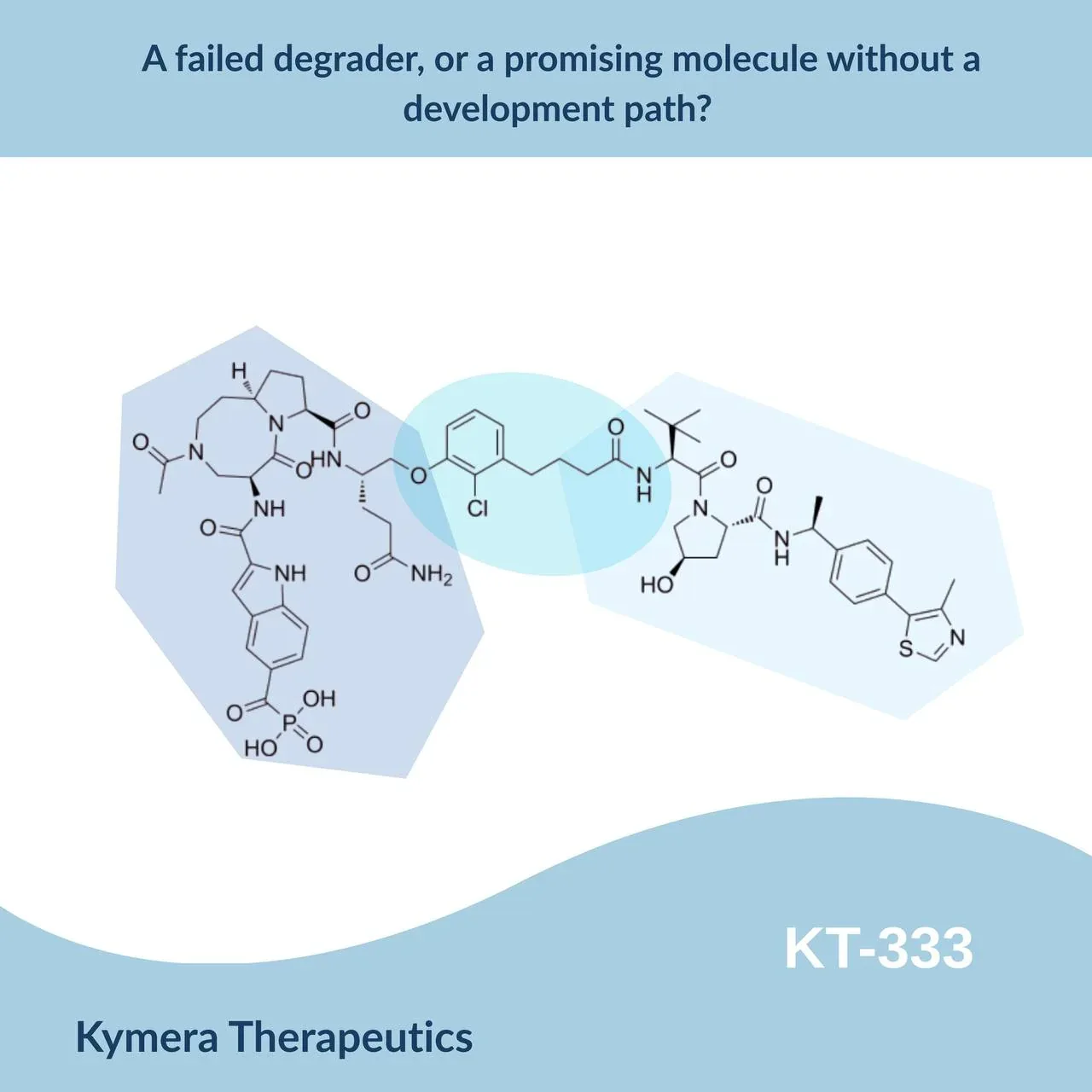
KT-333 achieved up to 95% STAT3 degradation in patients, yet its development stopped after Phase I. What makes this PROTAC particularly interesting is its linker, which helps create an entirely new interaction surface between STAT3 and VHL. The clinical results demonstrated substantial target degradation and encouraging antitumor activity, although important questions remained.
KT-333 (lirodegimod), developed by Kymera Therapeutics, is a heterobifunctional PROTAC targeting STAT3, a transcription factor that has long been challenging to address with conventional small molecules. Its molecular design provides a particularly interesting example of how linker architecture can influence degradation efficiency and selectivity.
A 2.5 Å cryo-EM structure of the STAT3–KT-333–VHL ternary complex revealed an unusual feature: the linker adopts a bent conformation and becomes completely buried in a newly formed pocket between STAT3 and VHL. This approximately 752 Å2 pocket is stabilized by extensive hydrogen-bonding and hydrophobic interactions, contributing to positive ternary-complex cooperativity (α = 4.6).
The linker therefore does much more than connect two ligands. It helps create an additional molecular recognition surface that stabilizes the entire protein–protein assembly. Interestingly, residues involved in this interface are not conserved across other STAT family members, providing a structural explanation for the remarkable selectivity of KT-333.
Kymera also demonstrated that VHL-recruiting degraders provided more potent and consistent STAT3 degradation than CRBN-based analogues. The resulting ternary-complex geometry enables rapid, site-specific ubiquitination of STAT3 at K707 and K709.
This is precisely why PROTAC linker optimization requires more than adjusting chain length or molecular flexibility. Attachment vectors, conformational preferences, steric complementarity and potential interactions with both protein surfaces can influence whether a ternary complex is sufficiently stable and correctly oriented for productive ubiquitination. A linker modification that appears minor from the perspective of conventional SAR may substantially alter degradation potency or selectivity.
But did this sophisticated molecular design translate into clinical activity?
The Phase I results published in Blood in November 2024, followed by expanded data presented at ASH in December, included 56 heavily pretreated patients.
KT-333 achieved mean maximum STAT3 degradation of up to 95% in peripheral blood mononuclear cells at the highest dose level. Among nine response-evaluable patients with classical Hodgkin lymphoma, five achieved objective responses, including three complete responses. Four of nine evaluable patients with cutaneous T-cell lymphoma experienced partial responses. Importantly, tumor biopsies confirmed reductions in STAT3 and phosphorylated STAT3, demonstrating that the mechanism extended beyond peripheral blood.
The safety profile was not without limitations. Dose-limiting toxicities, including stomatitis, arthralgia and fatigue, were reported, and the small patient cohorts left considerable uncertainty regarding efficacy and long-term tolerability. Nevertheless, the findings provided convincing proof of mechanism and signals of clinical activity.
Despite this, Kymera announced in October 2024 that it would not advance KT-333 beyond Phase I without a development partner, prioritizing oral degraders for immunological diseases instead.
KT-333 required weekly intravenous administration and would have needed further investment in oncology trials. Although IV administration is common in cancer treatment, the complexity and cost of clinical development inevitably influence portfolio decisions. Kymera’s stated rationale was strategic resource allocation rather than a demonstrated failure of STAT3 degradation.
Interestingly, the scientific story continued
In February 2026, a study published in Leukemia provided additional evidence supporting STAT3 degradation as a strategy against venetoclax-resistant acute myeloid leukemia (AML).
The researchers identified STAT3 upregulation as an important contributor to venetoclax resistance, associated with increased MCL1 expression and mitochondrial dysfunction. In preclinical models, KT-333 reduced STAT3 and MCL1 levels and significantly improved survival in mice with venetoclax-resistant AML.
Although these findings do not establish clinical efficacy in AML, they suggest that STAT3 degradation may have therapeutic relevance beyond the indications explored in the original clinical program.
Does this make KT-333 a failure?
Its clinical potential remains unresolved, but its contribution to targeted protein degradation is difficult to dismiss. KT-333 demonstrated how carefully engineered linker geometry can promote selective degradation of a challenging transcription factor, and that this mechanism can operate in patients.
The unresolved question is whether another development strategy could translate these molecular and biological achievements into a clinically viable treatment.
KT-333 illustrates an important reality of modern drug discovery: a scientifically successful molecular design does not always become a commercially sustainable medicine.
Kymera Therapeutics: full AACR 2024 structural poster (PDF)
Kymera Therapeutics: expanded clinical results, ASH December 2024 poster (PDF)
Kymera Therapeutics: Third Quarter 2024 Financial Results and Business Update, October 31, 2024
ClinicalTrials.gov: KT-333 Phase I, NCT05225584
Enamine Germany